
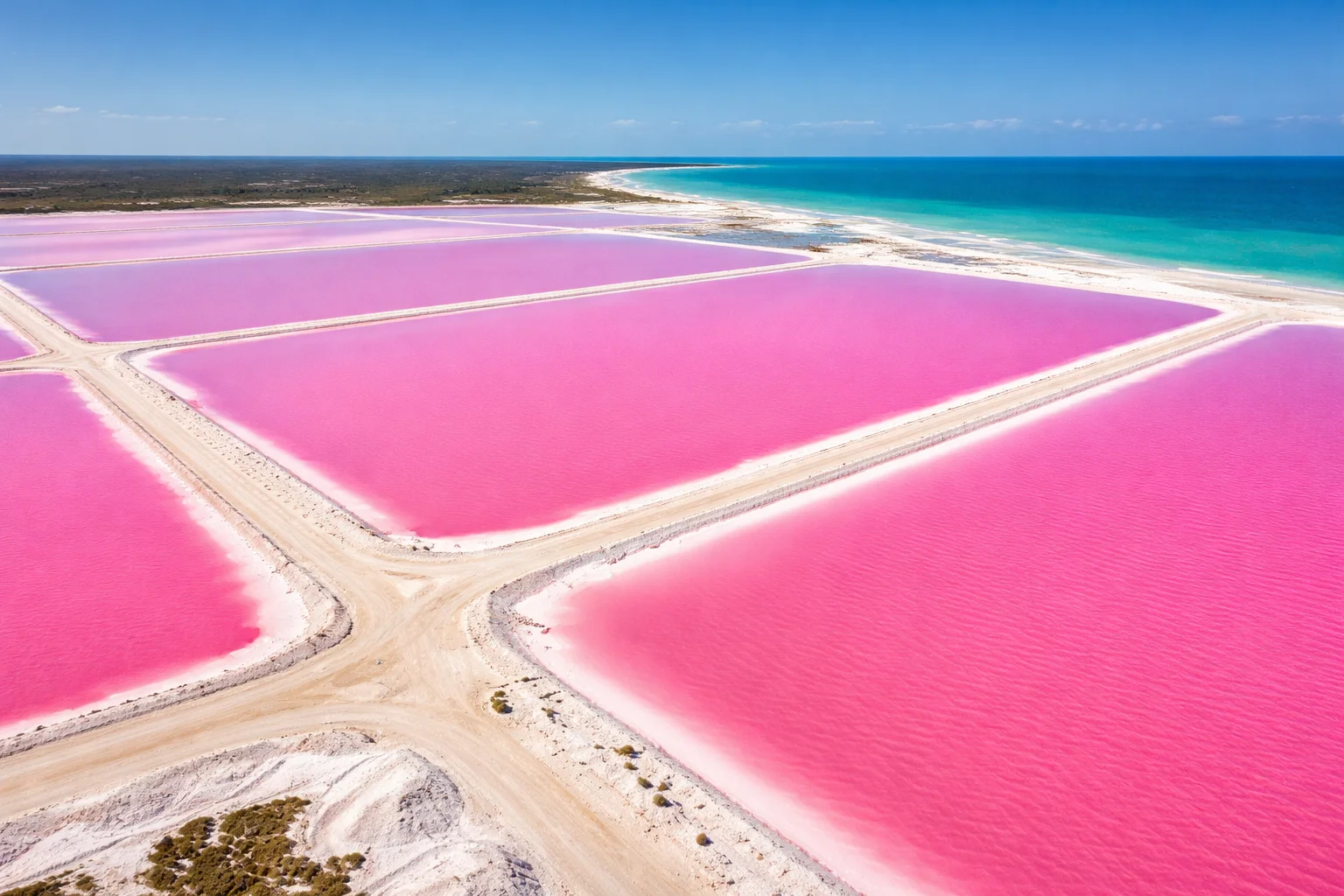
Las Coloradas is a group of bright pink salt ponds located on the northern coast of the Yucatán Peninsula in Mexico. At first glance, the water looks artificial, almost like it has been dyed. The color appears too vivid to be natural. However, the pink shade is not caused by chemicals or added pigments. It is the result of natural biological and environmental processes that occur in extremely salty water.
Understanding why Las Coloradas is pink requires looking closely at salt concentration, microscopic organisms, sunlight, and the chemistry of pigments produced under stress conditions. When these elements combine in the right balance, the water turns various shades of pink, from soft blush to deep reddish tones.
The Role of High Salt Concentration
Las Coloradas is part of an active salt production area. The ponds are shallow evaporation basins where seawater is directed and left to evaporate under intense sun. As water evaporates, the salt concentration increases. Over time, the water becomes hypersaline, meaning it contains much more salt than ordinary seawater.
Most living organisms cannot survive in such extreme conditions. However, certain microorganisms are specially adapted to thrive in highly saline environments. These salt-loving organisms are the key to the pink color.
Halophilic Microorganisms and Pigment Production
The main reason Las Coloradas appears pink is the presence of halophilic microorganisms. “Halophilic” means salt-loving. These organisms include specific types of bacteria and microscopic algae that grow in hypersaline water.
One of the most important organisms in this process is a microalga called Dunaliella salina. This alga produces large amounts of a red-orange pigment known as beta-carotene. Beta-carotene is the same type of pigment found in carrots, which gives them their orange color.
In environments with intense sunlight and very high salt levels, Dunaliella salina increases its production of beta-carotene. The pigment helps protect the cells from damage caused by strong sunlight and oxidative stress. As millions of these microscopic algae multiply in the water, their pigments tint the ponds pink.
Alongside the algae, certain halophilic bacteria also produce reddish pigments. These pigments combine with the algae’s color, intensifying the overall shade of the water.
How Sunlight Influences the Pink Color
Sunlight plays a critical role in the intensity of the pink appearance. The ponds are shallow, and the Yucatán region receives strong sunlight throughout much of the year. High solar radiation encourages the growth of halophilic microorganisms and increases pigment production.
When sunlight is strong and evaporation is high, salt levels rise, and microorganisms respond by producing more protective pigments. This results in deeper pink or reddish hues.
On cloudy days or during periods of heavy rainfall, the color may appear lighter or less vibrant. Rainwater can dilute the salt concentration, temporarily reducing the stress conditions that trigger intense pigment production.
Why the Shade of Pink Changes
Las Coloradas does not always look the same. The color can shift between pale pink, coral, and deep red depending on several factors:
- Salt concentration
- Water depth
- Sunlight intensity
- Evaporation rate
- Stage of the salt harvesting process
When salt levels are extremely high and microbial populations are dense, the color becomes more vivid. If the water is freshly pumped in from the sea and not yet highly concentrated, it may appear more orange or even closer to a normal blue tone before gradually turning pink.
The ponds are part of a working salt production system. As water moves through different stages of evaporation, each basin can display slightly different shades.
See also First-Time Renter’s Guide to Lakewood
Is the Pink Color Natural or Artificial?
The pink color of Las Coloradas is natural. No dye or artificial coloring is added to the water. The color forms through biological activity in response to environmental stress conditions.
However, the ponds themselves are part of a managed salt production facility. Seawater is channeled into constructed basins to speed up evaporation and salt crystallization. While the infrastructure is industrial, the pink coloration is entirely the result of natural microbial processes.
The Connection to Brine Shrimp
Brine shrimp also live in hypersaline environments. These small crustaceans feed on the algae and microorganisms present in the ponds. Like the algae, brine shrimp accumulate carotenoid pigments in their bodies.
These pigments can intensify the reddish appearance of the water when shrimp populations are high. In other saline ecosystems, brine shrimp are known to contribute to water coloration, and they also play an important role in the broader food chain.
Why Flamingos Are Linked to Pink Lakes
Flamingos are often associated with pink lakes, including those near Las Coloradas. Flamingos feed on brine shrimp and algae rich in carotenoid pigments. Over time, these pigments accumulate in their feathers, giving them their distinctive pink color.
Although flamingos are commonly seen in the wider region, especially in protected wetland areas nearby, their color does not cause the lake to turn pink. Instead, both the lake and the flamingos share a common source of pigmentation: carotenoid-rich microorganisms.
Comparison with Other Pink Lakes
Las Coloradas is not the only pink lake in the world. Similar phenomena occur in other hypersaline environments.
Lake Hillier in Australia displays a stable pink color due to salt-loving microorganisms and algae. Lake Retba in Senegal becomes intensely pink during dry seasons when salt concentration rises. Salina de Torrevieja in Spain also shows pink coloration caused by halophilic microbial activity.
In each case, the underlying principle is the same: extreme salinity supports microorganisms that produce red or orange pigments, which tint the water.
Can You Swim in Las Coloradas?
Swimming is generally not permitted in Las Coloradas. The area functions as an industrial salt production site, and access is controlled. The water contains extremely high levels of salt, which can irritate the skin and eyes.
Additionally, walking into the ponds can disturb the delicate balance of microorganisms responsible for the color. For these reasons, visitors are typically allowed to observe the ponds from designated areas rather than entering the water.
Environmental and Ecological Importance
Hypersaline ecosystems like Las Coloradas may appear harsh, but they support specialized life forms uniquely adapted to extreme conditions. These microorganisms contribute to nutrient cycles and form the base of a simple but important food web.
The nearby coastal wetlands and protected areas provide habitat for birds, fish, and other wildlife. The interaction between salt production activities and natural ecosystems requires careful management to maintain ecological balance.
Disturbances such as pollution, excessive tourism pressure, or major changes in water flow could affect microbial populations and alter the appearance of the ponds.
Why Las Coloradas Looks Unreal in Photos
The pink color often appears especially vivid in photographs. Several factors enhance its appearance:
Shallow water allows sunlight to reflect strongly. White salt flats surrounding the ponds create high contrast. Clear skies intensify the brightness of the color.
In person, the shade may vary depending on weather and viewing angle, but the pink hue is real and visible to the naked eye.
The Science Behind the Beauty
The striking pink of Las Coloradas is not a mystery once the underlying science is understood. The color is a visible sign of extreme environmental conditions. High salt levels create stress for microorganisms, prompting them to produce protective pigments. These pigments accumulate in the water, transforming ordinary seawater into vibrant pink ponds.
The phenomenon demonstrates how life adapts to extreme environments. What looks unusual or artificial at first glance is actually a natural response to salt, sunlight, and survival mechanisms at the microscopic level.
Las Coloradas stands as a clear example of how biological processes shape landscapes in unexpected ways. Its pink color is not magic, not paint, and not illusion. It is the result of salt, sunlight, and microscopic life working together in one of nature’s most visually striking displays.
