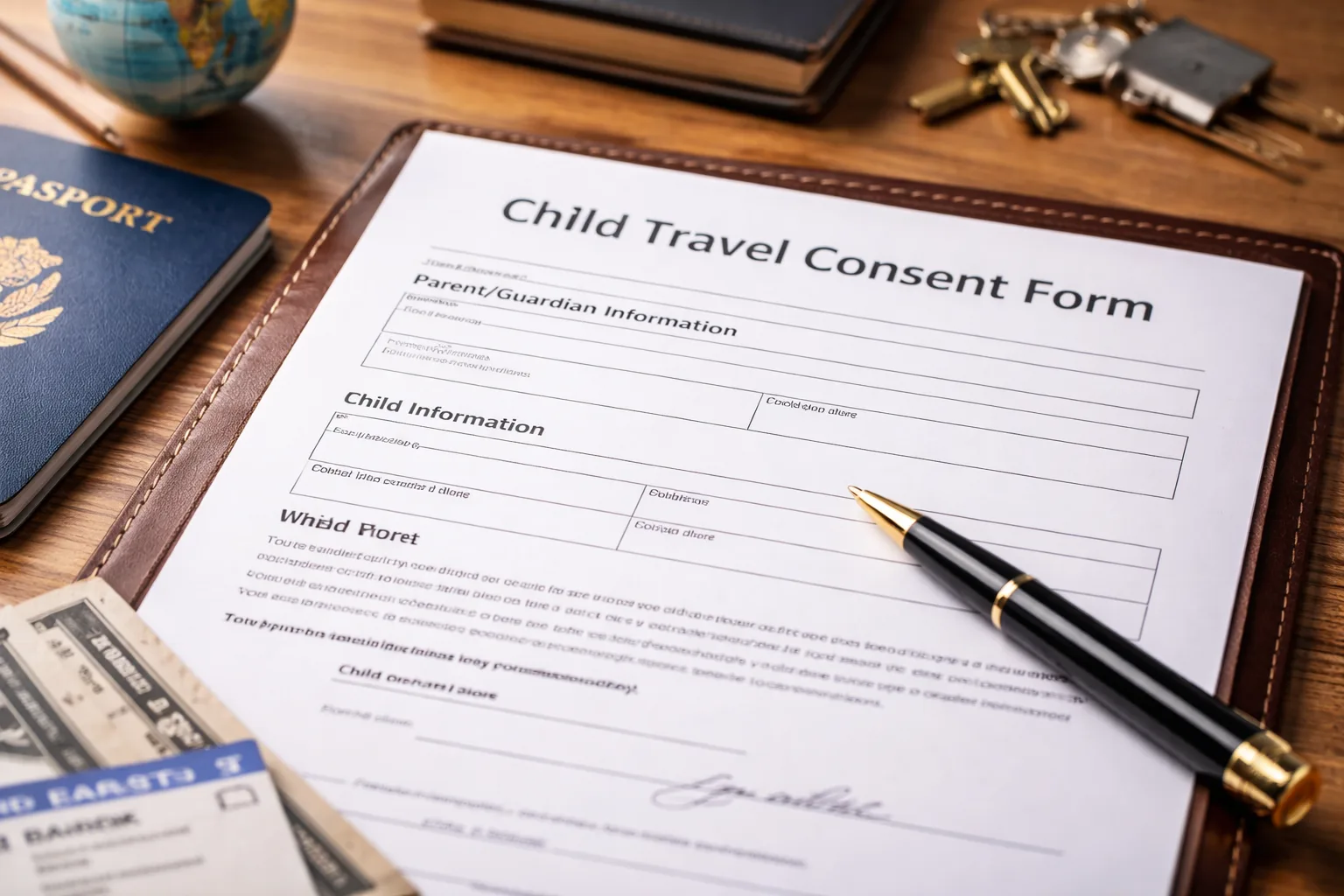
A child travel consent form is a legal document that confirms a child has permission to travel without one or both parents or legal guardians. It is commonly required when a minor travels internationally, crosses borders with only one parent, or travels with another adult such as a relative, school group, or family friend.
This document helps authorities verify that the child is traveling legally and with proper authorization, reducing the risk of disputes, delays, or travel refusal.
What Is a Child Travel Consent Form?
A written authorization for a child’s travel
A child travel consent form is a signed statement from a parent or legal guardian granting permission for a minor to travel. It confirms who the child is, who is responsible during travel, where the child is going, and for how long.
The form acts as proof that the travel has been approved by those with legal authority over the child.
When the form is typically used
A child travel consent form is most often used when:
- A child travels with only one parent
- A child travels with someone who is not a parent or guardian
- Parents share custody and one parent is not present
- A child travels internationally or across borders
Some airlines, border agencies, and immigration officers request it routinely.
Also, explore Travel Tips for Long-Distance Partners Preparing for the UK
Why a Child Travel Consent Form Is Important
Preventing travel disputes and delays
Without proper consent documentation, authorities may delay or deny a child’s travel. A consent form helps clarify that:
- The trip is authorized
- No custody dispute is involved
- The accompanying adult has permission to travel with the child
This reduces questioning and processing time.
Protecting the child’s safety
The form helps prevent unauthorized travel and protects minors from being taken across borders without permission. It is an important safeguard used worldwide.
Supporting custody and guardianship rules
In cases of shared custody or guardianship, a consent form helps demonstrate compliance with legal arrangements.
Who Needs a Child Travel Consent Form?
Children traveling with one parent
When a child travels with only one parent, especially internationally, a consent form from the other parent is often requested.
Children traveling with another adult
If a child travels with a grandparent, relative, teacher, coach, or family friend, a consent form is strongly recommended.
Children traveling alone
Unaccompanied minors may also require a consent form depending on airline rules and destination requirements.
Children under shared custody arrangements
Courts and border authorities often require proof that both parents have approved the travel.
What Information a Child Travel Consent Form Includes
Child details
The form usually lists:
- Full name of the child
- Date of birth
- Passport number (if applicable)
Parent or guardian information
Details of the parent or guardian giving consent typically include:
- Full name
- Contact information
- Relationship to the child
Travel details
Clear travel information is essential, such as:
- Destination country or countries
- Travel dates
- Purpose of travel
Accompanying adult information
The form identifies who the child is traveling with and their relationship to the child.
Signature and date
A signed and dated form confirms that permission is current and valid.
Does a Child Travel Consent Form Need to Be Notarized?
Notarization requirements vary
In many cases, notarization is not legally required but is strongly recommended. Some countries and airlines specifically request notarized consent forms.
A notarized form:
- Confirms the identity of the signing parent
- Adds credibility and legal weight
- Reduces the chance of refusal or questioning
International travel often requires notarization
For international trips, notarization is commonly expected, especially when traveling across strict border controls.
Is a Child Travel Consent Form Legally Mandatory?
Depends on destination and authority
There is no single global rule. Requirements depend on:
- Destination country
- Airline policies
- Immigration and border authorities
- Custody laws
Some destinations require it explicitly, while others leave it to officer discretion.
Airlines and border officers can still request it
Even if not legally mandatory, officials may ask for a consent form to confirm authorization.
How Long Is a Child Travel Consent Form Valid?
Validity depends on the travel dates listed
Most consent forms are valid only for the specified travel period. Once the trip ends, the form no longer applies.
Multiple trips may require separate forms
If a child travels frequently, parents may prepare new consent forms for each trip or specify a defined date range.
Common Situations Where a Consent Form Is Requested
International flights
International travel is the most common scenario where consent forms are requested.
Border crossings by land
Land border crossings may involve checks, especially when traveling with only one parent.
School or group travel
Schools and organizations often require consent forms for trips involving minors.
Emergency travel situations
Even in urgent cases, having a consent form can prevent complications.
What Happens If a Child Travels Without a Consent Form?
Possible delays or refusal
Authorities may delay travel or refuse entry if consent documentation is missing or unclear.
Additional questioning
Parents and children may be questioned to verify travel authorization.
Trip disruption
In some cases, travel plans may be canceled or postponed.
Tips for Using a Child Travel Consent Form Correctly
Keep copies accessible
Carry both printed and digital copies during travel.
Ensure accuracy
Names, dates, and passport numbers should match official documents exactly.
Use clear language
Ambiguous wording can lead to confusion or delays.
Prepare in advance
Do not wait until the last moment to complete or notarize the form.
Child Travel Consent Form vs Other Travel Documents
Not a substitute for a passport
A consent form does not replace a passport or visa.
Complements custody documents
In shared custody cases, a consent form supports but does not replace court orders.
Supports airline and border requirements
It works alongside tickets, identification, and travel approvals.
FAQs
Is a child travel consent form required for domestic travel?
Often not required for domestic trips, but some airlines or situations may still request it.
Can one parent sign the consent form?
Yes, but some cases require signatures from both parents depending on custody arrangements.
Does the form need to be in English?
Some destinations prefer the form in English or bilingual format.
Should the child carry the consent form?
The accompanying adult should carry it, but having a copy with the child can help.
Final Thoughts
A child travel consent form is a simple but important document that helps ensure smooth, lawful travel for minors. It confirms parental permission, supports custody rules, and reduces the risk of delays or refusal at borders.
For any situation where a child travels without both parents, preparing a clear, accurate consent form is a practical step that protects both the child and the accompanying adult.